Story
Nursing Prioritization and Delegation: 7 Essential NCLEX Tips Every Student Should Know
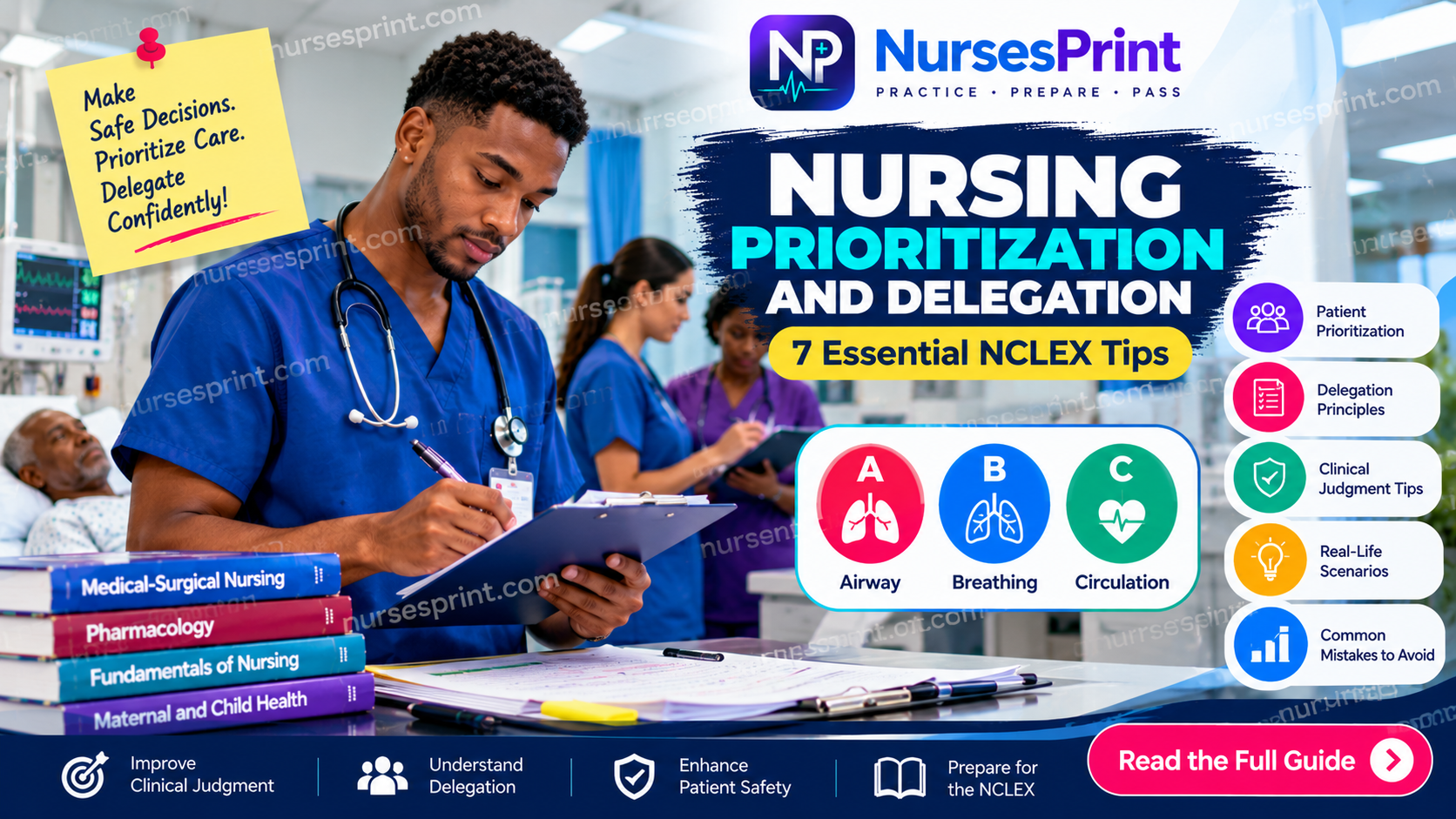
Imagine beginning a busy hospital shift with four patients needing your attention. One reports mild discomfort. Another needs scheduled medication. A third suddenly develops difficulty breathing.
Which patient should you assess first?
This is exactly the type of clinical decision nursing students must learn to make.
Nursing prioritization and delegation are essential skills for safe patient care. They also play an important role in NCLEX preparation because they evaluate your ability to recognize urgent situations and assign responsibilities appropriately.
Understanding these seven principles can strengthen your clinical judgment and improve your examination readiness.
1. Master the ABC Framework
The ABC framework helps nurses recognize immediate physiological threats.
A — Airway: Identify airway obstruction or compromised airway protection.
B — Breathing: Assess respiratory distress and inadequate oxygenation.
C — Circulation: Recognize serious bleeding, shock and impaired perfusion.
For example, a patient experiencing sudden respiratory distress generally requires more immediate attention than a stable patient requesting assistance with routine activities.
However, always evaluate the complete clinical situation rather than applying ABC rules automatically.
2. Recognize Unstable Patients
One important nursing prioritization principle involves distinguishing stable patients from those experiencing deterioration.
Warning signs include:
Sudden changes in consciousness
Severe breathing difficulties
Uncontrolled bleeding
New neurological deficits
Rapidly worsening vital signs
Patients with potentially life-threatening changes often require immediate assessment.
3. Understand Nursing Delegation Responsibilities
Delegation involves assigning appropriate nursing activities to qualified team members while maintaining accountability.
The nurse must consider patient stability, task complexity, staff competence and applicable regulations.
The National Council of State Boards of Nursing delegation resources provide guidance on safe delegation principles.
Remember that delegation responsibilities vary according to professional roles and jurisdictional requirements.
4. Apply the Five Rights of Delegation
The Five Rights of Delegation provide a useful framework for assigning nursing activities.
They include:
Right Task: Is the activity appropriate for delegation?
Right Circumstances: Is the patient stable and the situation suitable?
Right Person: Is the team member qualified?
Right Direction: Are instructions clear?
Right Supervision: Can the nurse monitor performance and evaluate outcomes?
Understanding these principles helps prevent unsafe delegation decisions.
5. Practice Clinical Judgment With Patient Scenarios
Consider this NCLEX-style practice question.
A nurse receives reports about four patients. Which patient requires immediate assessment?
A. A stable patient requesting assistance with breakfast.
B. A patient awaiting routine discharge instructions.
C. A patient experiencing sudden shortness of breath and chest discomfort.
D. A patient requesting an additional blanket.
Correct Answer: C
Rationale: Sudden respiratory distress and chest discomfort may indicate a serious clinical emergency. Immediate assessment and appropriate intervention are necessary.
Regular scenario-based practice strengthens your ability to recognize priorities.
Explore NursesPrint NCLEX-RN practice questions to support your preparation.
6. Understand Infection Prevention Priorities
Infection prevention protects patients and healthcare workers.
Nurses must recognize situations requiring appropriate precautions and timely interventions.
Important considerations include hand hygiene, personal protective equipment and transmission-based precautions.
The CDC infection control guidance provides authoritative recommendations for healthcare settings.
Understanding these principles supports safer clinical decisions.
7. Avoid Common NCLEX Prioritization Mistakes
Students sometimes select answers based on routine nursing activities rather than immediate patient needs.
Avoid these mistakes:
Ignoring signs of deterioration.
Delegating activities outside a team member's responsibilities.
Failing to consider patient stability.
Prioritizing convenience over patient safety.
Memorizing frameworks without understanding their application.
Practice interpreting the entire clinical scenario before selecting an answer.
Frequently Asked Questions
What is the most important nursing prioritization principle?
Identifying immediate threats to patient safety is essential. The ABC framework can help guide decisions when clinically appropriate.
Can nurses delegate patient assessments?
Comprehensive nursing assessments and clinical judgments generally remain responsibilities of appropriately licensed nurses. Specific delegation rules depend on jurisdiction and professional scope.
How can I improve NCLEX prioritization skills?
Practice clinical scenarios regularly and review explanations to understand why particular patients or interventions require priority.
Final Thoughts: Think Like a Safe Nurse
Effective nursing prioritization requires critical thinking, clinical judgment and patient safety awareness.
By understanding delegation responsibilities and practicing realistic clinical scenarios, you can become more confident in making appropriate nursing decisions.
Ready to improve your NCLEX clinical judgment skills?
Visit NursesPrint and explore nursing practice questions designed to support your examination preparation.
Practice smarter. Strengthen your clinical judgment. Prepare with NursesPrint.