Story
Nursing Dosage Calculations: Essential Formulas, Examples and Study Tips
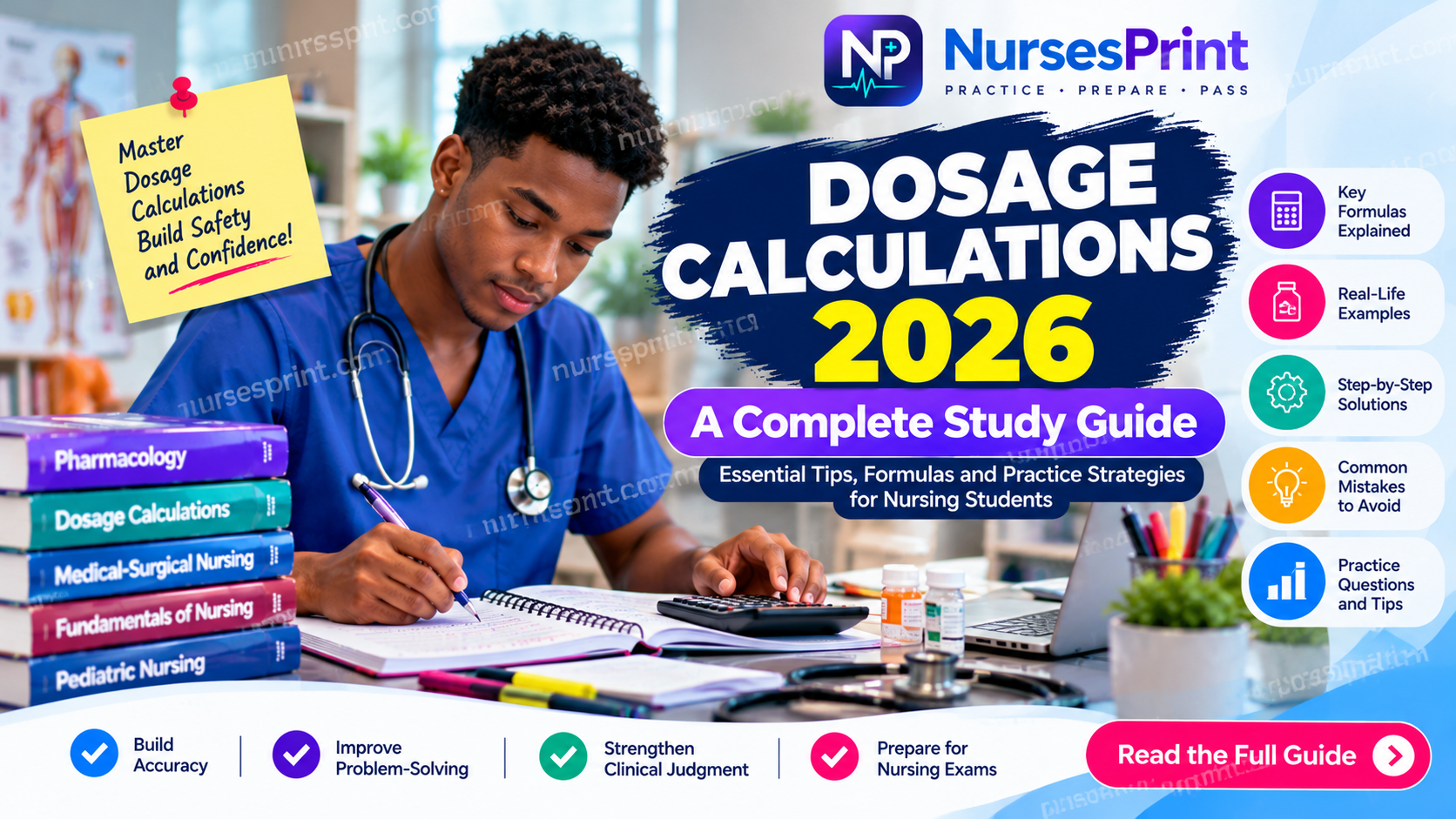
Imagine preparing to administer medication during a busy hospital shift. You have the prescribed dose, the medication label and a patient depending on your accuracy.
One incorrect calculation could compromise patient safety.
That's why nursing dosage calculations are among the most important mathematical skills every nursing student must develop.
Whether you're preparing for nursing school examinations, the NCLEX-RN or the NCLEX-PN, understanding medication calculations helps build confidence and supports safe clinical practice.
This guide explains essential dosage formulas, practical examples and common mistakes to avoid.
1. Understand the Basic Nursing Dosage Formula
One of the most frequently used methods for calculating medication doses is the desired-over-have formula.
Formula:
Dosage to administer = (Desired dose ÷ Available dose) × Quantity
Where:
Desired dose (D): The medication amount prescribed.
Available dose (H): The medication strength supplied.
Quantity (Q): The volume or number of units containing the available dose.
Example: Tablet Dosage Calculation
A patient is prescribed 500 mg of medication.
Each tablet contains 250 mg.
Calculation:
(500 mg ÷ 250 mg) × 1 tablet = 2 tablets
Answer: 2 tablets.
Always verify that the calculated dose is appropriate for the prescribed medication and patient.
2. Master Essential Medication Conversions
Medication calculations frequently involve converting between measurement units.
Important conversions include:
Measurement | Equivalent |
|---|---|
1 gram | 1,000 milligrams |
1 milligram | 1,000 micrograms |
1 liter | 1,000 milliliters |
1 kilogram | 1,000 grams |
Example: Converting Grams to Milligrams
A medication order specifies 0.75 grams.
Convert this amount into milligrams.
Calculation:
0.75 × 1,000 = 750 mg
Answer: 750 mg.
For reliable medication safety information, consult the U.S. Food and Drug Administration.
3. Learn IV Flow Rate Calculations
Intravenous medication administration requires careful calculation.
For an infusion pump, the basic formula is:
Flow rate (mL/hr) = Total volume (mL) ÷ Time (hours)
Example: IV Infusion Rate
A patient is prescribed 1,000 mL of IV fluid over eight hours.
Calculation:
1,000 ÷ 8 = 125 mL/hr
Answer: 125 mL/hr.
This educational example assumes a straightforward continuous infusion. Actual administration requires verification of the prescription, patient condition and institutional protocols.
4. Avoid Common Dosage Calculation Mistakes
Medication errors can occur when nurses overlook essential safety checks.
Common mistakes include:
Confusing milligrams with micrograms.
Using incorrect measurement conversions.
Misplacing decimal points.
Failing to verify medication concentrations.
Rounding calculations incorrectly.
Ignoring patient-specific dosing requirements.
The Institute for Safe Medication Practices provides valuable educational resources about medication error prevention.
Safety tip: Use a leading zero for decimal doses below one and avoid unnecessary trailing zeros. For example, write 0.5 mg rather than .5 mg.
5. Practice Nursing Medication Math Regularly
Understanding formulas is only the beginning.
Regular practice helps you recognize different calculation methods and identify mistakes.
Begin with simple tablet calculations before progressing to liquid medications, weight-based dosing and intravenous infusions.
Review every incorrect answer to understand where your reasoning went wrong.
You can explore additional nursing examination preparation resources through NursesPrint.
Frequently Asked Questions
What is the easiest way to calculate medication doses?
The desired-over-have formula is useful for many straightforward dosage calculations. Dimensional analysis is another valuable method.
Are dosage calculations included in nursing examinations?
Medication calculations are commonly assessed in nursing education and may appear in nursing licensure examinations.
How can I improve my medication math skills?
Practice consistently, master unit conversions and verify your calculation steps.
Final Thoughts: Accuracy Is Essential in Nursing
Nursing dosage calculations are more than mathematical exercises. They are essential patient safety skills.
By understanding medication formulas, practicing regularly and learning from mistakes, you can strengthen your calculation abilities.
Always remember that clinical medication administration requires more than correct arithmetic. Appropriate verification and adherence to medication safety procedures remain essential.
Ready to strengthen your nursing knowledge?
Explore NursesPrint Nursing Exam Preparation for additional educational resources and practice opportunities.
Practice smarter. Prepare confidently. Build your nursing future with NursesPrint.